


~ように【1.為了2.勸告3.希望】
前后使用动词,表示为了使该状态・状况成立而做/不做…的意思;有时也可省略に。在ように的前面多使用なる,できる等与人的意向无关的表示无意向行为的动词和表示可能的V-れる,或者动词否定形等表示状态性的意思的表达方式,后面的句子一般是表示说话人意向行为的动词;前后主语可以像例(1)~(3)那样不同,也可以像例(4)那样是同一主语;
另外,前后主语一致,前面的动词也是表示意向性动作时,一般使用ために。
Using a verb before and after, this means “do... so as to make such a circumstance or situation occur/do... so as not to....”に is sometimes omitted. Before ように, verbs which show non-volitional actions, such as なる and できる, or verbs which show possibility in the form V-れる are often used, as are the negative forms of verbs and expressions which show the state or condition of a thing. The clause which follows ように is a verb which demonstrates the speaker’s intentional act. The subject may differ before and after, as in examples (1)-(3), or it may be the same, as in (4).
Furthermore, in cases where the subject is the same before and after, and where the first verb demonstrates an intentional action, it is usual to use ために.
是对听话人表示忠告或劝告的表达方式;后半部使用しなさい/してください或お願いします等动词,有时也可省略这些动词而以ように结尾;另外,也可省略ように的に,但是像例(5)、(6)那样用ように结尾时一般不能省略。V-ないように的形式,多表示否定性的忠告・劝告。
Used to give advice to or to remonstrate with the listener. Verbs such as しなさい/してください and お願いします are used in the latter half but are sometimes omitted, in which case the expression ends with ように. Also, it is possible to omit the に from ように but, where the sentence ends with ように, it is usual not to do so, as in examples (5) and (6). Used in the form V-ないように, this often expresses negative advice or recommendations.
是对自己或他人,表示祈祷、希望的表达方式。ように的后面使用祈る、祈念する、念じる、望む、願う、希望する,期待する等动词;也可像例(5),(6)那样以…よう(に)结尾;这时一般…ように的前面要用敬体,在演讲、书信的结束语中经常使用;
Expresses one’s or another’s hopes, prayers and wishes. Verbs such as 祈る(pray), 祈念する(say a prayer), 念じる(pray silently), 望む(desire), 願う(wish), 希望する(hope) and 期待する(expect) are used after ように. As in examples (5) and (6), the expression can end with ように. In such cases the polite form is usually used before ように. It is often used to bring a speech or letter to a close.
后半部使用言う、伝える等表示传达的动词,用于间接引用所要求的内容时;如表示直接引用时要按下面命令や依頼の表現+と+伝達の動詞的形式。
Using verbs of communication, such as 言う(say) and 伝える(convey) in the latter half, this is used to indirectly quote a request. Direct quotations take the following form: command/request+と+verb of communication.
表示将使其行为或状况成立作为目标,而进行努力/用心/照料;像例(4)~(6)那样使用否定形时,意思是将不使其成立作为目标;例(3)和例(6)意思是要使其成为习惯;一般都在ように的前面使用动词,但有时也会像例(2)那样使用V-やすい的形式,这时也可以说読みやすくする。
Means to make efforts with the aim of/to aim to/to see to it that an action or situation occurs. As in examples (4)-(6), when the negative form is used, it means to aim for the action or situation not to occur....ようにしている of (3) and (6) means to do that thing customarily. A verb usually comes before ように but, as in example (2), V-やすい is also used. In this case 読みやすくする could also be used.
接动词词典形,表示从不可能的状态到可能状态,或从不能实行的状态变化到能实行的状态;像例(1)那样多使用表示可能的V-れる的形式;像例(5)那样接续否定形时,表示向不实行状态的变化,这时也可以说言わなくなった。
Taking the dictionary form of verbs, expresses a change from a situation in which something is not possible to one in which it is, or, from one in which a thing cannot be realized to one in which it can. It is often used to express possibility in the form V-れる, as in example (1). In cases where the negative form is used, as in (5), it expresses a change to a situation in which a thing is not done. In this case 言わなくなった could also be said.
与ナ形容词的变化形式相同,其连用形,连体形分别是ように,ような。
Conjugating na-adjectives, this becomes ように and ような in the continuative and attributive forms.
将事物的状态・性质・形状及动作的状态,比喻成与此不同的其他的事物;不仅可以比喻成同一性质的事物,也可以比喻成完全是其他想像的事物;多附在名词或动词后面使用,偶尔也可以像例(6)那样附在イ形容词之后,但是不能附在ナ形容词之后;另外,有时也可伴随着像以下的あたかも、いかにも、さながら、まるで、ちょうど等表示添加意思的副词一起使用;
Used to liken a situation, quality, form, or action to something which is essentially different. Not only used to liken a thing to something with similar properties but also to entirely distinct, fanciful, things. Often attached to nouns and verbs but, occasionally, as in example (6), also attached to i-adjectives. However, cannot be attached to na-adjectives. Also, sometimes used with accompanying adverbs which are used to express similes, such as あたかも, いかにも, さながら, まるで and ちょうど.
有很多习惯、固定的用语;惯用表达方式除此之外还有雲をつかむような話/竹を割ったような性格/血のにじむような努力/手が切れるような新札/飛ぶように売れる/目を皿のようにして探す(不着边际的事/心直口快的性格/艰苦的努力/崭新的钞票/畅销/瞪大眼睛寻找)等;
口语中经常使用みたいだ。另外,书面语有时也使用ごとし。
Often appears in customary, fixed expressions. Idiomatic expressions other than those which appear here are: 雲をつかむような話/竹を割ったような性格/血のにじむような努力/手が切れるような新札/飛ぶように売れる/目を皿のようにして探す (a vague story/a straightforward character/to sweat blood/a crisp new note/to sell like hot cakes/to search with wide eyes) .
In speech, みたいだ is often used. Furthermore, in writing ごとし can also be used.
接动词的词典形,タ形,表示实际上不是那样,可是做的或感觉到的却像是那样的状态;多用于列举说明与事实矛盾或假想的事物时;
Taking the dictionary or ta-form of a verb, expresses that, although in reality (it) is not the case, one’s conduct or feeling is that it is. It is often used in cases which pick out things as examples which are inconsistent with reality or are imaginary.
在以Y叙述的事物和性质或内容、方法等方面,将一致的具体的人物或事物作为例子列举时,使用XようにY的形式;例(4)的意思是摹仿动作,例(5)可以和とおりに互换使用;
表示<比喻>的[ようだ1,是将本来与其不同的别的事物比喻成宛如…,而本句型的用法是将具有和Y同一性质或内容的X作为具体的例子列举出来;但是,这两种用法有时是相关联的,很难将其清楚地加以区别;
Taking the form XようにY, used to give a specific person or thing as an example of conformity/consistency in quality, content or method with Y. Example (4) means “to imitate an action” and (5) can be rephrased as とおりに.
In contrast to Usage 1 inようだ〈simile〉, an expression which compares an essentially different and distinct thing to X in the phrase まるでXのように, with this usage X is given as an example of a specific thing which shares a property or content with Y. However, it is not always possible to distinguish between these two usages.
将后续名词所表示的具体内容作为例子表示时使用该句型;比如在みかんのような果物中,后面的名词则表示含有前面的名词在内的以及比其更高一层的意思;接短句时没有ような也成立,不过在意思上会产生不同;比如从例(7)中去掉ような说成薬を飲んでもよくならない場合的话,是只限于那种特定场合的表达方式,但是要说成薬を飲んでもよくならないような場合的话,意思就是这以外还会有各种情况,不过比如在这种情况下;
Used to give a concrete example of the noun which follows it. For example, in みかんのような果物(a fruit like an orange), the latter noun represents a higher concept than the former. When continued after a clause, the sentence can be valid without ような but there will be some difference in the meaning if it is included or not. For example, if ような is removed from (7) as 薬を飲んでもよくならない場合 it refers to a specific situation where “the condition does not improve after taking the medicine,” but in case of 薬を飲んでもよくならないような場合 then it means “cases like when you take the medicine but the condition does not improve” indicating that there are many other similar situations.
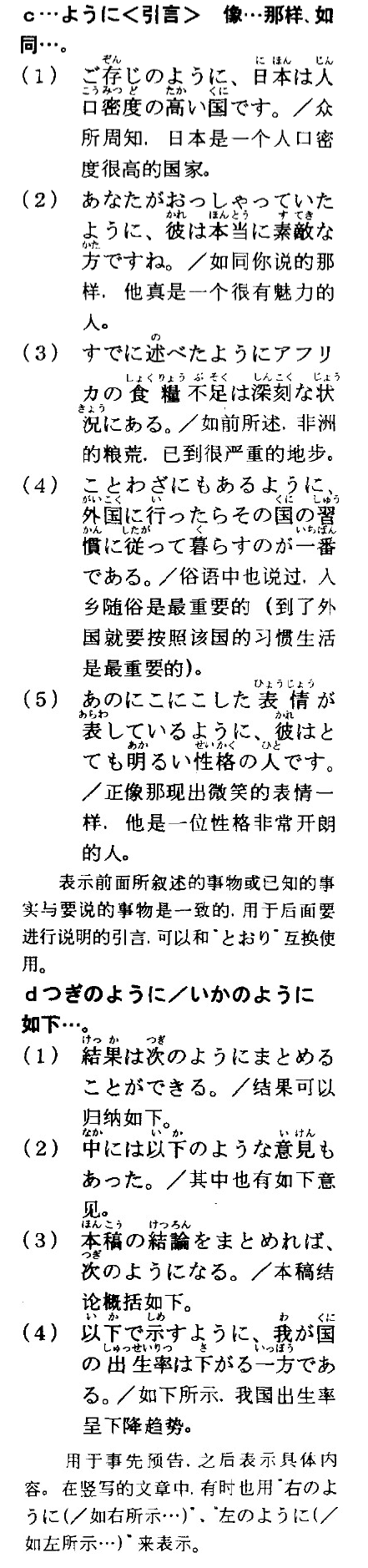
表示前面所叙述的事物或已知的事实与要说的事物是一致的,用于后面要进行说明的引言,可以和とおり互换使用。
Shows that what is about to be said is consistent with what has been stated previously or is a well-known fact. Used to give notice that further explanation is about to be given. Can be replaced with とおり.
用于事先预告,之后表示具体内容;在竖写的文章中,有时也用右のように(/如右所示…),左のように(/如左所示…)来表示。
Used to announce that concrete detail is to follow. In vertical text compositions, 右のように and 左のように are also used.
〜ように N4
意味目標を実現させるために〜する
接続
V(辞書形) + ように
V(ナイ形)+ ように
Vは無意志動詞(見える、聞こえる、わかる、なおる、可能動詞など)
例文
- JLPTに合格できるように、勉強した単語や文法を復習します。
- ホワイトボードの字がよく見えるように、前の席に座ります。
- 日本語を上手に話せるように、毎日シャドーイングをしています。
- 日本語初級者でもわかるように、やさしい日本語で話します。
- 来年、海外旅行ができるように、お金を少しずつ貯めています。
- 友達が日本に留学できるように、祈っています。
- 子供でも飲めるように、少しコーヒーを甘くしました。
- 日本語で漫画が読めるように、毎日日本語を勉強しています。
- 太らないように、甘いものは食べないことにしています。
- 明日、寝坊しないように、今日は早く寝ます。
- 誰にも気がつかれないように、こっそりと家を出た。
- 忘れないように、メモをしておきます。
- 地震が起きても慌てないように、家族との連絡方法を決めておきます。
- 明日、遠足でしょ? ちゃんと、起きられるように今夜は早く寝なさい。
- おじいちゃんに聞こえるように、大きな声で話します。
意味
接続の違い
・「〜ために」は意志動詞と接続する。・「〜ように」は無意志動詞と接続する。
ニュアンスの違い
・「〜ために」は目的を達成するという意志が強い。・「〜ように」は目的を達成するために頑張って何かをするというニュアンスがある。また、「息子が試験に受かるようにお祈りする。」のようにお願いする時にも使う。
例文
- 「~ために」と「~ように」の違い
意味
具体的な例を挙げる時に使う
接続
V(普通形) + ような / ように
Nの + ような / ように
備考
話し言葉では「〜みたいな」を使う
例文
- 彼が持っているような鞄が欲しいです。
- 彼はまだ小学生なのに、大人が読むような難しい本を読んでいます。
- 私は大阪のような賑やかな街が好きです。
- 私は父のような真面目な人になりたいです。
- チョコレートのような甘い物が大好きです。
- 彼のように日本語が上手に話せるようになりたい。
- 子供でもわかるように、わかりやすい言葉で説明してください。
- 一度でいいから、王様のような暮らしがしてみたい。


コメント